While MCMXC A.D. was a scandalous album disguised as scolding, the second album, ‘The Cross of Changes’ tries to explain the difficulty of making a decision.
As the title of the album suggests, there is a man at crossroads who has to make a difficult decision. The decision, no matter what it is, bears a lot of weight and consequences, which shall bring changes in the life, be in the life of narrator, or someone else.
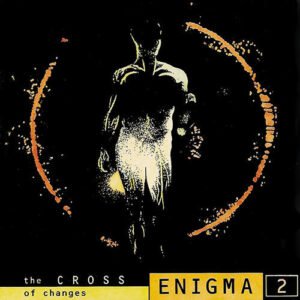
The cover of the album shows a man who seems to be walking out of that red circle, which I believe has been camouflaged well as the light of Sun. Although I don’t have extraordinary knowledge about such imagery (naturally, you have to read plenty of philosophy and esotericism) my interpretation of this could be the first time when man emerged and walked into this earth to find himself. It fits quite well with the theme of self-discovery and enlightenment (also the theme of Dante Alighieri’s Divine Comedy, purifying yourself of all your sin)
While the red circle behind him could be the sunlight. He is coming out of the dark to face the light. If we consider this a man’s journey through self-discovery, you could also link it to the numerology or the circle of life. It starts with 1, which is the beginning, and it ends with 9, which is the death and the period of transformation. While stepping into 10 it will still bring us 1, through 1+0. In the end, the number one will start as your own rebirth after 9.
The first song of the album, ‘Second Chapter’, already explains it perfectly. The journey of man has always had to be a chameleon-like journey or simply the life of a snake who sheds its skin. It means that man already goes through phases in his life where he has to discover himself, which also come through making difficult decisions. “The debts of hundreds years” signify the ever-existing sins that humans have always committed and will commit, the same sins mentioned in Alighieri’s masterpiece.
And that’s why people have come to this earth, to discover themselves, so they could finally reach the light.
The Eyes of Truth
It is said that the eyes are the mirrors to the soul. They say everything about you. No matter if you’re angry, if you’re sad, if you are happy or if you are in love. The eyes will always tell the truth. And the eyes who display the emotions, shall observe anyone who will notice.
In the video-clip, however, it shows a young baby who is left by his mother to float above the river, and who grows up and lives among the elephants. He lives and travels with them. Later on, their forest is burned down by villagers, but they manage to escape.
Elephants are the smartest animals on earth whose intelligence can challenge that of the dolphin (we will see it below too). Elephants, who are said to possess deep empathy and emotion, are also preys of many hunters. In the video-clip which show the villagers burning down the forest where the boys and the elephant live could signify a very subtle metaphor of someone’s soul that was hurt by the others.
A forest or the nature is a representation of Gaia or the Mother Earth in Greek mythology, who is deeply protective of her children, and in addition, the sample being a Mongolian song that is a call from the mother who wait for her son to return fits perfectly.
Which is why the choice of that of the young boy and the elephants (who have the highest emotional intelligence among animals) seem deliberate. It doesn’t mean that there is a literal mother who waits for the young boy, but something close to paradise. A paradise of nature and animals.
But who the villagers or the hunters represent here, perhaps the outside world who hurt this young boy.
On the other side, the journey continues with the elephants in search for another land and there is another village and a town that welcomes him and treats him like a prince. But the journey will definitely not end there.
Return to Innocence
From what I’ve seen in people’s reactions it’s widely regarded as the most beautiful song of Enigma, ever. A lot mistake ‘innocence’ for guilt-free in front of law, the innocence of oppressed people from the conquerors, or simply the innocence in regards to sexual availability. However, innocence here has dozens of meanings: it is about the childlike innocence of an adult, the only thing that a human being cannot fake, because it comes out naturally.
The childlike innocence or inner child is preserving your curiosity, your naivety, optimism and happiness that make someone stand out from the others, finding joy in smallest things and carrying yourself full of light. It’s not to be mistaken with immaturity, instead, it’s something pure that could only be gained, judging by the title, through the journey of man itself, to self-discovery, to purification.
Thus, innocence is also related to the state of purification, and a place exempt of sin, much like the Heaven or the Garden of Eden of Dante Alighieri. It is also why Dante had to be purified in rivers before being taken by Beatrice, who was the writer’s childhood love and remained so until his death, so he could go back to Heaven, the definition of innocence.
The video-clip being played backwards was also a deliberate choice, as confirmed by Michael Cretu himself. Every action and every event in the video is played on rewind, similar to a DVD cassette which you want to turn back to revive the same beautiful memories from the start.
On the first glance it looks like a portrayal of a time in reverse, of an old man who died and then the time went back all the way to when he was born. However, this is only scratching the surface. The old man who picks the quince, picks a special, ancient fruit that symbolizes love, happiness and wisdom. This music-video is a whole allegory of wanting to let the ‘old self’ die so the new self begins. And this is a conscious choice.
Because the old man who picks a quince doesn’t symbolize an old memory when he ate them as a child. He picks it up because the “old self” has become wiser and experienced enough. Now, they will be ready to start again. We will see these themes over and over again.
The lyrics, however, are plea that the narrator makes whether to himself, or to another person, to return to that state of being that make him stand out from the others. It should be noted that the lyrics are very personal, and this is the second time we see the mention of a “friend”. If in the first album there was scolding, this one seems like compassion and empathy.
The narrator is hurting when he sees this sad state of depression, whether is it in himself, or a close friend of his. One shouldn’t be afraid to let out their weakness, it makes them human. But you need to be strong to continue your journey.
“Just look into your heart, my friend. That’ll be the return to innocence”
To look into your heart it means to recognize what you need to do. It doesn’t mean you need to act on emotions, if you’re already being asked to cry and let it out. You’re being asked to follow a voice that will guide you to that journey. The voice is inside you (Virgil).
I Love You… I’ll Kill You
Quite ‘on your face’ title, the same as the lines in the lyrics. This song starts with an immediate recognition from the narrator: he recognizes the magnitude of everything that a love can bring. The magnitude of someone’s love that is poured onto the other. Sometimes, love is not just the feeling of comfort and warmth in someone else’s chest. Love is also the feeling of sorrow that could emerge from the betrayal or the impossibility.
Love can bring destruction just like it can bring comfort all at the same time. You can always love just as much as you can hate. That’s why “Love and hate are one in all”. The narrator knows this very well, because one day, the person he loved or even himself, could turn from an angel into the devil in no time. He will love and hate at the very same magnitude. You can feel the happiest in someone else’s arms, yet one day, you’d have no problem burying a knife in that chest instead.
But why does ‘sacrifice turn into revenge’? Sacrifices in love are a little hard to define in this case. They could’ve sacrificed themselves to be with the person, or they could’ve sacrificed the relationship to prioritize self-preservation. So if we make the link here, that’s the weight of a difficult decision that someone has to make. One of them had to choose reason over emotion, because after all, this would bring both of them to self-destruction.
Which brings us to the exact topic of this album; the position of being at crossroads. Man has to decide what they have to do with the magnitude of this love that is eating both of them alive.
If they stay in this love, it will bring them to hate each other, if it’s already this dangerous enough. If they leave, they will prioritize to endure loneliness for the sake of mutual self-preservation. Well, this already means that the narrator already chose the second option, because the line says it all: “Loneliness, I feel loneliness in my room…” They made the difficult decision, and it was maybe the worst, much needed decision he had to make.
So let’s ask the questions: what are these songs really about? Are these songs of Enigma about a love that was too perfect in theory, but too difficult to maintain in practice? Was it so destructive, that the separation for self-preservation was much needed? Could this even be related to ‘Return to Innocence’ and ‘Sadeness’?
Silent Warrior
In many songs of ‘Enigma’, it often happens that the lyrics could have total lack of relation to the song-title. As always you have to guess if there is any relation or not.
The lyrics especially show quite clearly how throughout the centuries, wars were waged upon innocent and indigenous people of America and Africa in the name of God and while holding a giant crucifix on their hands. The colonizers did not spare anything, they stole their gold and their culture, in return they gave them the Bible, because their reasoning had always been that it’s God’s will.
What is the relation of the title with the lyrics? Let’s say that in such circumstances, one can do nothing more but choose to endure the suffering. Once the conquistadors and the conquerors were victorious, the oppressed were the ones who chose to endure this colonization for centuries. They chose to endure conquests, centuries of assimilation, poverty and wars. In this sense, they’re ‘silent warriors’.
It’s somewhat romanticizing suffering as something admirable. And today, the effects of the conquest are clearly seen.
To be a silent warrior can also be related to the self. If you choose to endure hardships in your life and leave nothing to see for the others. You’re battling with yourself, you’re battling with the difficulties of life. And you still chose to endure. But is it worth it?
The Dream of The Dolphin
As it’s written in the album credits, Cretu dedicated this particular song to his ex-wife, Sandra.
As with the elephants that are the smartest animals on land, dolphins are the smartest animals on water. But unlike elephants who can live and travel with humans, dolphin can’t live with humans, and the human cannot live with the dolphin. They simply live in two different ecosystems.
That’s why to become a man is the dream of the dolphin. To live among humans is the dream of the dolphin. It sounds too poetic and lonely.
In itself, the message is also not to ask for more than you have. This can also be linked very well with the man’s desire for greed, lust and luxury.
But it’s doubtful whether this song fits Sandra quite well.
The beginning of the lyrics are quite interesting as well, and somewhat they also show the genesis of things. The beginning before you see something beautiful. You need a light to see the colors, and you need a stone to create a crystal. A crystal or a diamond is something everlasting and indestructible.
Age of Loneliness
As the difficult decision has been made, a difficult period comes, the age of loneliness. At this point, you have to wonder if this was truly how Michael felt during this period. I had come across this very old interview, you just have to pay attention to this particular statement from 2008:
I was not alone, but lonely. Now I’m alone, but not lonely
Whether these could be related, remains to be seen.
Even looking at the music video, it seems like a crowd of people floating above a large city. One can say that it’s normal to feel lonely in a crowd in a world that doesn’t understand you.
Out from the Deep
As is explained at the beginning of the analysis, the second chapter is to explain the man’s journey on earth, which is also an ulterior motive for the decision. In this song in particular, the extended lines make more sense, that it’s exactly about man’s journey to purification of the self.
To learn how to love properly, to love the right way. (Remember Dante from the first analysis). To learn how to live, to learn from mistakes and to avoid making them, otherwise it will make a never-ending cycle. To understand why everything happens for a reason and this shouldn’t mean that you have to doom yourself forever.
The Cross of Changes
This particular text that imitates the one from the second track, teaches that no matter how much the truth is in front of your eyes, there’s sometimes a tendency to ignore it and brush it off. Sometimes, they’re confused what to do with it. (They’re at crossroads) But the truth always comes out, in one way or another, in any shape or form. And the observer is still watching. It could potentially mean a subconscious desire to be understood. A man’s wish to be seen and understood for who he is. Even though his eyes say it all, he is still wanting to be understood.
How a real loner behaves.
Conclusion
While the imagery in the album show some esoteric messages (we will check them later) the songs pay justice to the title of the album. And we need to be very clear and blunt about what they are about.
The songs overall speak about a man at crossroads who had fallen deeply in love with someone, but had to make a difficult decision which truly changed their lives. He tries to explain this decision through the justification of self-preservation, which will be the journey of the self to purification. But because the narrator loves them very much, this won’t just be their own journey, but also the journey of their partner, which is why they keep on pushing them to look into their heart and find the voice that will guide them. Why?
Because the narrator keeps counting on them, even though the love must have been very dangerous to survive in, which in turn could’ve turned them into enemies. And this is absolutely not what the man wants.
Even in connection to the first album, the danger here for the man is how a love that was once pure could turn into hate and lust for gratification. It is also what Divine Comedy taught: To purify yourself and to learn to love the right way.
The question immediately arises: Could ‘Enigma’ have possibly been a personal confession of a romantic story right under people’s noses?